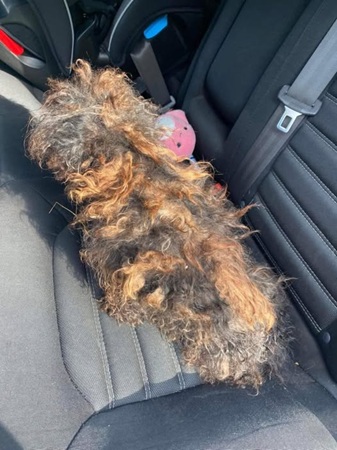
Her body was disappearing long before anyone noticed.
Long before anyone slowed down enough on that quiet Missouri roadside to truly see her, she had already been fading — piece by piece, day after day, breath after shaky breath.
Every bone in her body ached with the weight of neglect. Every attempt to move felt like scraping against a life that had forgotten she existed.
She had learned to take up as little space as possible, curling her trembling body into the roadside dust, hidden beneath a suffocating mass of matted fur that no longer resembled the coat of a dog.
She didn’t look like a living creature anymore. She looked like something discarded. Something that had tumbled from the back of a truck and been left to decay.
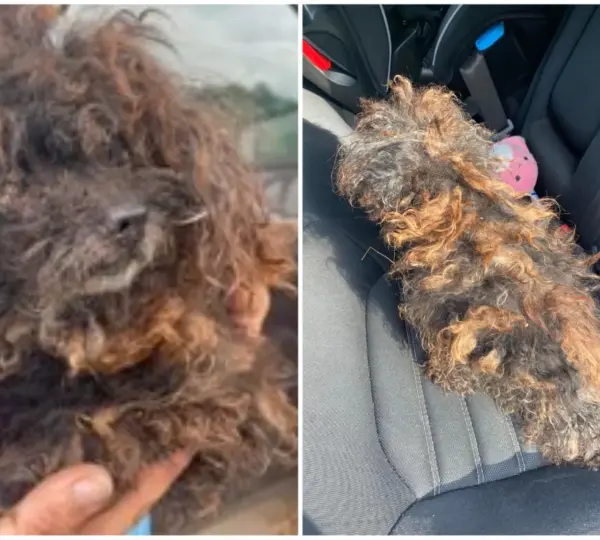
From a distance, she was only a shapeless bundle of filth — a collapsed shadow resting against gravel and weeds. Passing cars didn’t slow down.
People didn’t stop. Even the wind seemed to pass her by without noticing. The world that had once been loud and busy had become silent around her, muffled beneath fear, hunger, and the heavy mats that pulled at her skin like anchors.
It could have ended there, quietly and without witness. But fate shifted in the softest way — a glance, a hesitation, a vehicle easing onto the shoulder instead of speeding past.
Someone looked closely. Someone saw movement where no movement should have been. Someone recognized life in a place where life seemed impossible.
That moment was the beginning of Pear’s return.
The First Touch
When the rescuer approached her, the air around the small, hunched creature seemed to tighten. She expected harm — she had been taught by silence and abandonment to expect nothing else. B
ut when a hand slipped beneath the filthy, tangled mass of fur, something miraculous happened: she didn’t flinch. She couldn’t. She was too exhausted, too depleted, too far beyond the instinct to flee.
But she felt it.
The touch. The warmth. The quiet message carried through skin and bone: You are safe now.